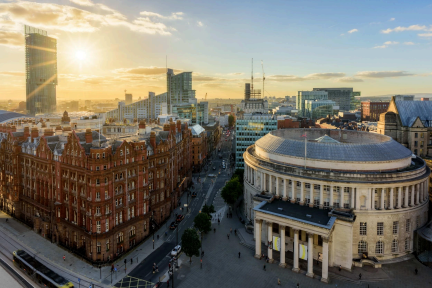
Manchester Calling
Ask almost any Brit and they’ll say the country’s broken. Yet many assume the system itself cannot change, only the politicians running it. Britain’s problems aren’t just the product of poor leadership, but of a state built around one city. National renewal means rebuilding the state so it works for the whole country. To be fully realised, then, it may need to begin somewhere else entirely: Manchester.
All Roads Lead to London
For nearly two millennia, Britain has revolved around London. Roman roads once converged on Londinium; today, railways, finance and political power still point in the same direction. The capital contains around 13% of the population yet produces roughly 22% of economic output. It pulls talent from across the country: nearly two in five top graduates move there within six months of finishing university. The result’s a self-reinforcing cycle: London grows stronger while other regions lose skilled workers and investment.
Yet this dominance benefits few. London has the country’s highest income inequality and rents swallow nearly half the average salary. Meanwhile the political class remains clustered around Westminster, often insulated from life elsewhere.
Despite decades of devolution rhetoric, fiscal and political authority still sits overwhelmingly in London. The result is an economy and political culture shaped inside a single metropolitan bubble – one that increasingly struggles to address the country’s wider challenges.
Lessons from History
Capitals aren’t permanent. Rome shifted power to Constantinople when the empire’s centre moved east, giving Emperor Constantine a blank slate free from Rome’s entrenched rivalries and modus operandi. Centuries later, Mustafa Kemal Atatürk followed similar logic, moving Turkey’s capital from Istanbul to the more central Ankara as he founded a modern republic.
Other states have done the same. Washington, D.C. balanced North and South. Canberra balanced Sydney and Melbourne. Brasília pushed development inland. Nigeria relocated its capital from Lagos to Abuja to bridge regional divisions.
Such projects aren’t perfect. Planned capitals can be costly and sometimes sterile, and economic power often remains elsewhere. But the logic’s clear: relocating a capital can rebalance a nation’s geography of power.
A Decentralisation Programme
Britain has some of the worst regional inequality in the developed world. The gap between London and the rest of the country is larger than in almost any major European economy. Increasingly Britain resembles two economies – the South East comparable to Western Europe, much of the rest closer to parts of Eastern Europe (nine of the top 10 poorest areas of northern Europe are in Britain, sans South East England).
Government promises of 'levelling up' have done little to reverse this trend. Cities such as Leeds, Glasgow and Birmingham retain enormous potential but, without structural reform and sustained public investment, inequality will persist. Breaking the cycle requires a proactive state willing to devolve power and build new institutions across the country.
Relocating the capital could anchor such a transformation. Government itself could be reorganised geographically, with ministries spread across the country – energy in Glasgow, transport in Birmingham, foreign affairs remaining in London – so national decision-making isn’t confined to a single metropolitan hub.
Britain already has experience with such moves. The creation of MediaCity in Salford doubled creative-industry employment while leaving London’s own media sector largely intact. Done properly, decentralisation can benefit both regions and the capital.
Manchester, D.C.
If Britain were to relocate its capital, Manchester would be the obvious choice. It sits far closer to the country’s geographic centre and lies outside Westminster’s entrenched power networks.
Symbolically the choice matters too. As the world’s first industrial metropolis, Manchester represents Britain’s industrial and working-class heritage far more clearly than the finance-dominated South East.
Nor would relocation require building a new capital from scratch. Greater Manchester already has more than three million people, strong transport links and substantial infrastructure. Completing HS2 to the city would strengthen the case.
Rather than upheaving Westminster overnight, a gradual transition over a decade – establishing a federal assembly, executive complex and supreme court in Manchester while many institutions remain in London – would be more realistic. Ministries could relocate in stages, as governments have done before. The aim wouldn’t be to diminish London but to rebalance Britain so political power reflects the whole country.
The Rise of Manchesterism
Public support has historically been limited. A 2018 YouGov poll found only one in eight Britons in favour of capital relocation, though Manchester was the most popular alternative among supporters.
Manchester’s resurgence since then strengthens the case. Once emblematic of post-industrial decline, the city’s grown at double the national average over the past decade. Newfound investment, talent, construction and infrastructure – such as the Bee Network – have transformed Manchester into the first credible challenger to London’s dominance in decades.
Under Mayor Andy Burnham, a model of 'Manchesterism' – regional empowerment, public investment and strong local leadership – has emerged as an alternative to Britain’s London-centric, finance-driven economic model. Moving the seat of government north could also widen the political talent pool beyond the narrow “Oxbridge-Westminster” pipeline.
A Break with the Old Geography
Relocating the capital wouldn’t solve Britain’s problems overnight. But it would mark a decisive break with the political geography that created them. For centuries power has been concentrated in one corner of the country, shaping an economy and political class increasingly detached from much of the nation they govern.
Moving the capital would send a different signal: that the British state belongs to the whole country, not just the city that has long dominated it.
Britain doesn’t need a single transformative leader – a modern Constantine, Atatürk, or De Gaulle – to change course. But change will not come from Westminster alone – we must force its abdication.
Moving the capital wouldn’t simply change where Britain’s governed from. It would change who the country’s governed for.
---
Joshua Smith – an engineering graduate – and Elliot Bloom – a filmmaker, cultural programmer, and writer – combine a technical foundation with cultural nuance, and a sharp understanding of the media climate. Over the past year, the pair have worked on creating a new political project to bring progressive politics back to the working class.
All blog posts represent the views of the author alone and not necessarily those of Mainstream.
