Labour’s losses in the 2026 local elections came from a long-term splintering of its voter coalition, collapsing favourability ratings, and a governing strategy increasingly shaped by stopping Reform’s rise.
Data from the 2025 British Election Study (BES) shows that chasing Reform voters has fractured the broad, liberal-leaning coalition that delivered Labour its 2024 landslide.
A Coalition Already Coming Apart
Labour entered government with a huge majority but a fragile voter base. The party won 411 seats on just 34% of the vote through a highly efficient distribution of votes, which masked how thin its support was.
By summer 2025, the BES showed that Labour had retained only 51% of its 2024 voters, see Figure 1. The biggest single group of losses came from uncertainty: 20% of Labour’s 2024 voters stated they did not know who they would support, 1.92 million people.
The next largest group of losses occurred to left-liberal progressive parties (The Lib Dems and Greens): 18.4% of Labour’s 2024 voters, 1.79 million people.
By contrast, Reform had taken 8.2% of Labour’s 2024 voters, around 796,000 people. Whilst significant, it must be noted that this was still less than half the number Labour lost to liberal-left parties. This shows how Labour was likely to face substantial losses long before entering the local election campaigning period, showing the damage was done on the first year of governing.
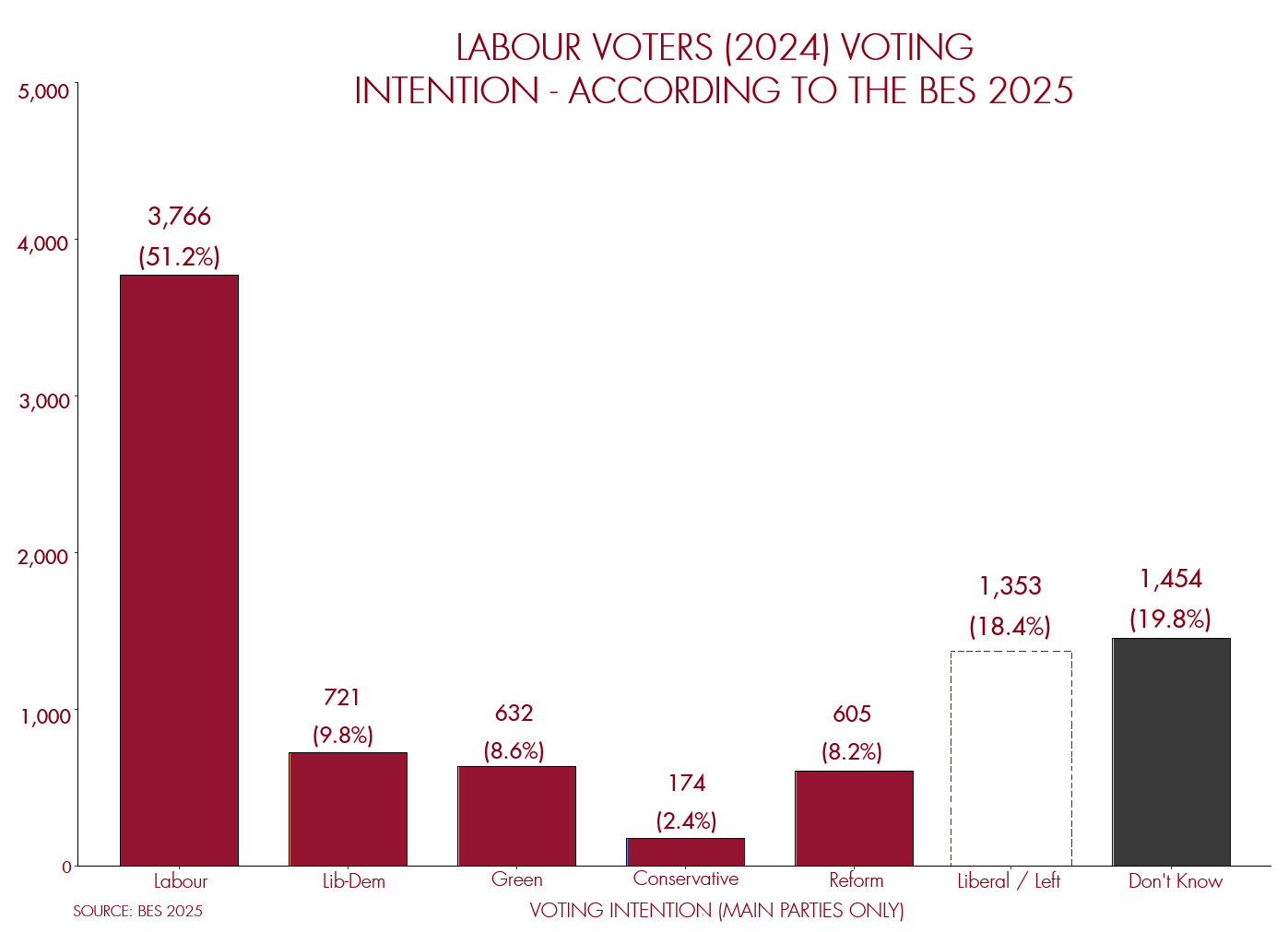
Figure 1: Current voting intention of all individuals who voted Labour in the 2024 general election (Note: the analysis cuts SNP & Plaid due to small sample sizes). It shows Labour is losing more to Left/Liberal parties. Source: BES 2025.
Vitally, BES data shows that these different flows of voters comprise contrasting voter groups that have opposing values and preferences, see Figure 2.
Green/Lib Dem switchers are:
Reform switchers are:
Whilst these voters do share some concerns, such as the cost of living, they clearly have important political differences. Therefore, a strategy aimed at primarily winning back Reform voters has likely alienated the liberal voters Labour needs to preserve the majority of its 2024 voter coalition. This annoyance of Labour’s core base, whilst not preventing losses to Reform, contributed to Labour’s large local election losses. This can be most seen on the subject of immigration.
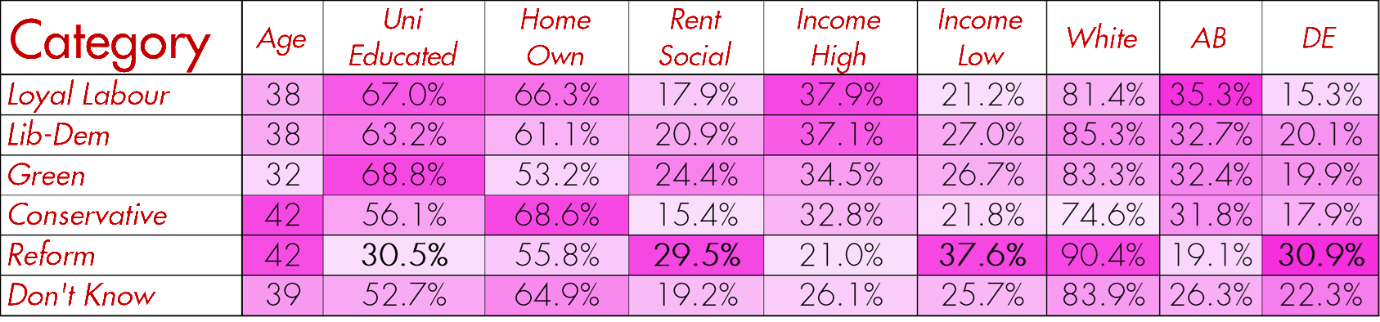
Figure 2: A table showing the demographic composition of voters Labour has lost to various parties since 2024. Source: BES 2025.
The Immigration Trap
A key part of Labour’s strategy to stop Reform was to “get tough” on immigration. However, the BES shows this strategy has likely done more harm than good.
Reform to Labour switchers have concluded that Reform, not Labour, is the party that can most deliver on their core concern. 77% of them believed Reform was best placed to handle their top issue, which was overwhelmingly immigration. Despite Labour’s strong stance on the subject, 88% believed immigration had increased, even though it had fallen by 475,000. Therefore, there is no evidence that Labour’s rhetoric on immigration is allowing them to stop losses to Reform. This was also the case in the general election, where the voters Labour lost in 2019 did not return to Labour, but switched to Reform instead.
Meanwhile, there is evidence that this position has driven liberal voters away:
It is important to note that 33% of Green switchers said they would accept immigration increasing, and a majority agreed they could unite around a position of maintaining current levels of immigration. Yet, Only 6% believed Labour shared their position, with many feeling that Labour was a party focused on reducing immigration.
Labour’s negative rhetoric around immigration may also be causing it problems because 34% of Lib Dem switchers and 45% of Green switchers believe immigration to be economically beneficial, see Figure 3. Therefore, speeches which have portrayed immigration as a negative may have alienated the very voters saying that they will no longer back Labour.
Consequently, as these voters outnumber those with concerns about immigration, Labour’s attempt to outflank Reform on immigration likely has lost it more support than it has gained. This put Labour into a weak position going into the local elections and can partly explain why Labour failed to secure the majority of seats it was defending.
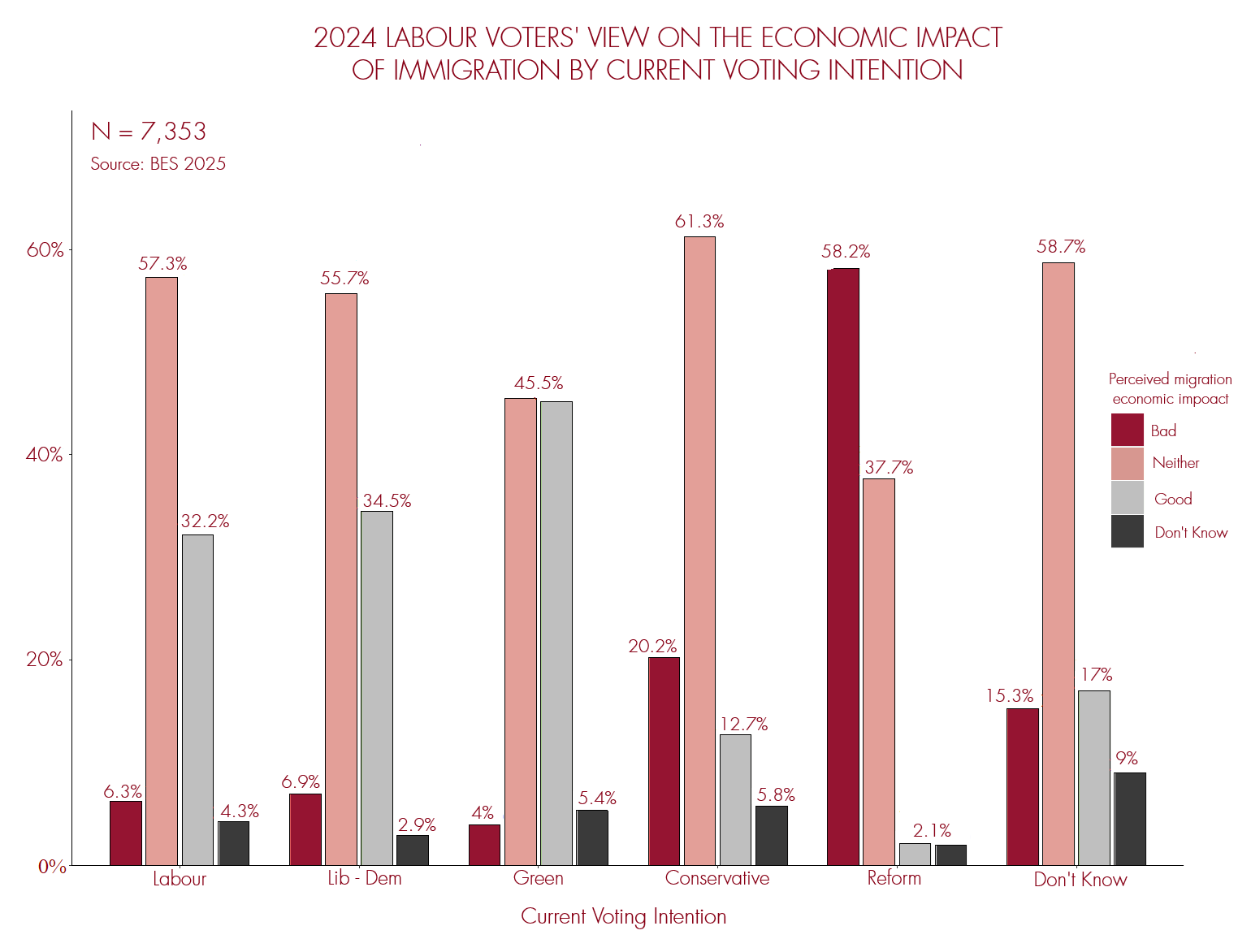
Figure 3: 2024 Labour voters’ view on the economic impact of immigration by their current voting intention. Voters lost to Left/Liberal parties view immigration positively, whilst those lost to Reform are more negative. Source: BES 2025.
Economic Disappointment unifying people against the government
Across every group except Reform switchers, the economy was the number one priority: 64% of Labour loyalists, undecided voters, Lib Dem switchers, Conservative switchers and Green switchers said the economy should be the government’s focus.
Yet, Labour’s first year in office left many feeling worse off:
Figure 4 shows that two-thirds of voters who left Labour believed the government had weakened the economy. 47% of Labour-to-Lib Dem/Green switchers say their personal finances had worsened, and 60% of Labour-to-Reform switchers say the same. This feeling of being worse off is likely contributing to a belief that the Labour government is not delivering, thus explaining why many former voters turned elsewhere in the local elections.
Cuts to winter fuel payments, proposed disability benefit reforms, and tax changes have landed badly. YouGov and More in Common both found that these unpopular policies were more salient than Labour’s achievements. Subsequently, voters who felt economically squeezed no longer trusted Labour to deliver, keep to their commitments and felt the party no longer represented them. Therefore, perceived policy failings also likely have contributed to a decline in Labour candidates’ ability to deliver, thus making it harder for Labour candidates to win in the 2026 local elections.
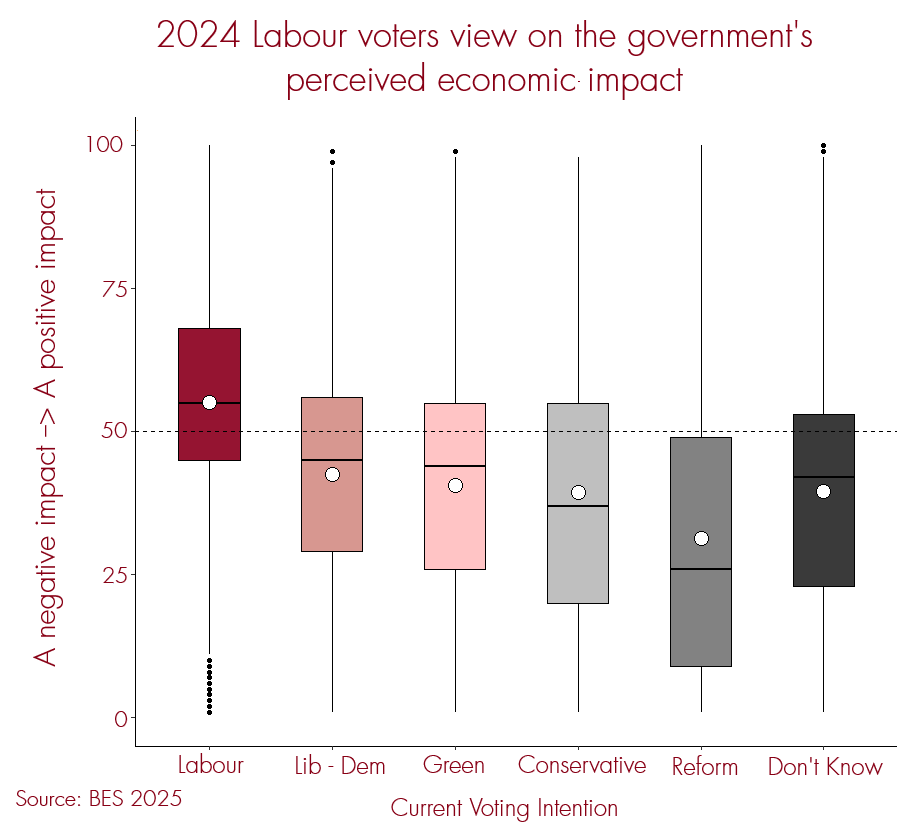
Figure 4: 2024 Labour voters’ view on the government’s perceived economic impact by their current voting intention (0-100 scale). It shows that the voters Labour lost perceive the new government to have worsened the economy (below the black dotted line). Source: BES 2025.
A weakened Party Brand
Labour also went into these local elections with a much weakened party brand. In 2024, 69% of Labour voters viewed the party positively. By 2025, that had fallen to 44, a 25-point drop. Meanwhile, unfavourability rose by 12 points.
Among those who left Labour: 32% of Green switchers now viewed Labour unfavourably, which was also the case for 25% of Lib Dem switchers and 60% of Reform switchers. Importantly, this is not just about disappointment in policy, but a wider disappointment that many of these voters perceive that the government is not behaving as they would expect a Labour government to. Many former Labour voters have told polling companies they now saw the party as too right-wing, including 25% of Green switchers and 15% of Lib Dem switchers. Therefore, it is likely that Labour’s attempt to chase Reform voters has confused voters about Labour’s identity and weakened the party’s brand appeal. Consequently, Labour candidates in these local elections will have struggled to connect with progressive voters, helping to explain Labour’s losses to the Greens and why Reform could beat Labour on relatively low vote shares.
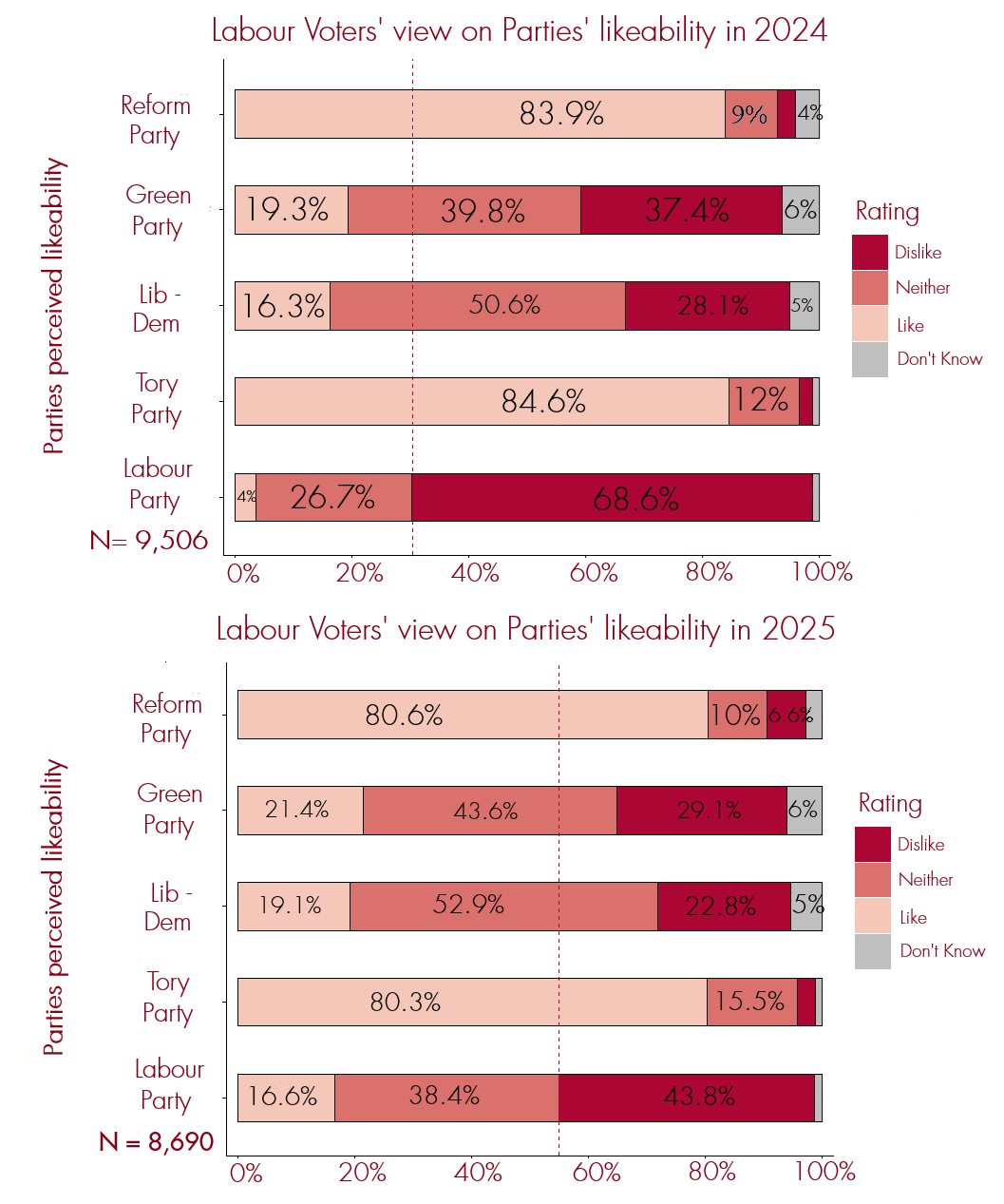
Figure 5: Labour voters’ favourability of the main parties in England, in 2024 and 2025. It shows that voters who saw Labour mostly favourably only two years ago now have less favourable views. Source: BES 2025.
Why Labour Lost support and the 2026 Local Elections
By the time voters went to the polls in 2026, Labour had:
This created a tough set of local elections for Labour as by polling day, Reform had surged in working-class areas, and the Greens and Lib Dems had strengthened in university towns and cities. Further, even undecided voters were of a mind to punish the government.
Overall, BES data tells a simple story: Labour’s 2024 voter coalition was broad but fragile. Chasing Reform has failed to secure those wavering to Reform, and it has alienated its more sizable left-liberal base. Until Labour stops chasing Reform and clearly communicates it is a progressive party that has had successes in government and can further deliver, electoral losses are likely to continue.
---
James Prentice is a political researcher and has gained a PhD from the University of Sussex. He focuses on analysing electoral politics and frequently writes on Labour's electoral challenges. This has led him to write a book on Labour's electoral challenges and he has also published summaries of this research with the Fabian Society, and Labour List. James is a member of the Hastings & Rye CLP and recently served on the Fabian Society NEC for two years. James is willing to write blogs and articles on a range of political subjects for progressive institutions.
All blog posts represent the views of the author alone and not necessarily those of Mainstream.
